









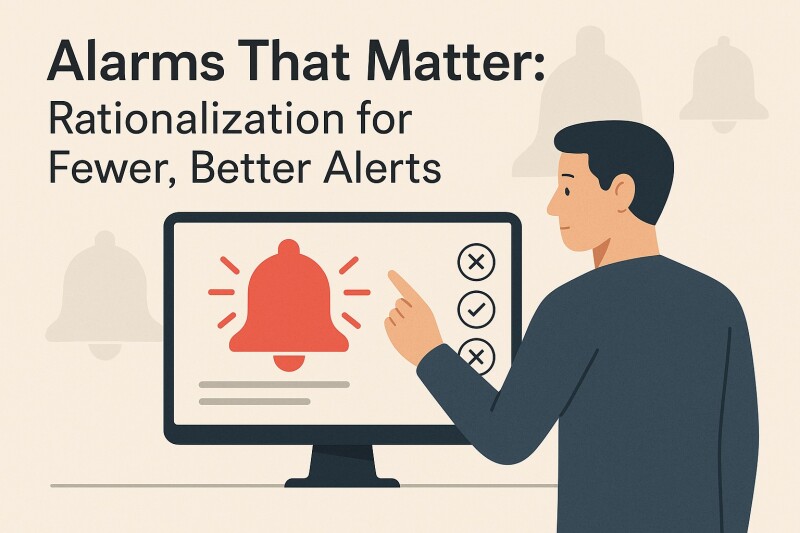
Alarms That Matter: Rationalization for Fewer, Better Alerts
Operators can’t respond effectively when screens flash hundreds of alarms per hour. Alarm floods lead to fatigue, missed incidents, and regulatory risk. Rationalization — the process of defining, prioritizing, and validating alarms — turns noise into actionable insight.
The Problem with Alarm Floods
- Duplicate or correlated alarms trigger simultaneously.
- Low-priority events use the same visual or sound pattern as critical ones.
- Many alarms are never acknowledged — a clear sign of desensitization.
Alarm Rationalization Steps
- Define clear severity levels and response expectations.
- Group related alarms into “causal” or “consequence” types.
- Eliminate chattering signals with deadband and time filtering.
- Audit performance monthly: frequency, duration, response time.
Leverage Standards
Follow ISA-18.2 or IEC 62682 to structure alarm lifecycle management. These frameworks reduce alarm counts by 50–80% without software replacement.
Case Example: Refinery Control Room
After rationalization, daily alarm counts fell from 1,500 to 250. Operator workload and incident response time both improved significantly.
Related Articles
- Cloud-Connected SCADA: Security, Latency, and Cost
- MQTT and OPC UA as SCADA Data Buses: Choosing Wisely
- Historian to Data Lake: A Safe Migration Path
Conclusion
Alarm management isn’t just configuration — it’s human factors engineering. Rationalized SCADA alarms protect both processes and people by ensuring every alert means something.

























Interested? Submit your enquiry using the form below:
Only available for registered users. Sign In to your account or register here.